
Is Stone Oak the Right Neighborhood for Your Family in San Antonio in 2026?
Stone Oak consistently ranks among North San Antonio's most desirable communities. Here is an honest, local breakdown of schools, home prices, commute times, and what buyers need to know before purchasing in 78258.
Is Stone Oak the Right Neighborhood for Your Family in San Antonio in 2026?
Stone Oak is one of North San Antonio's most consistently desirable places to live, and for most families the answer is yes. Top-rated NEISD schools, well-maintained streets lined with mature live oaks, a dense concentration of retail and medical services, and a strong long-term appreciation history make it a compelling choice for buyers relocating from out of state, upsizing locally, or putting down roots in the San Antonio area. The nuance is in the details, and that is exactly what I want to walk you through.
I am Scott C. Peck, Broker Associate and Business Development Director with JBGoodwin REALTORS in San Antonio. I have guided buyers and sellers through dozens of Stone Oak transactions, and I want to give you the honest read on this neighborhood that you would not find in a generic relocation guide.
What Sets Stone Oak Apart from Other San Antonio Suburbs?
Stone Oak is not a single subdivision. It is a collection of more than 30 planned communities within the 78258 zip code, loosely bounded by Loop 1604 to the south and U.S. Highway 281 to the east. What ties them together is a shared commitment to deed restrictions, maintained common areas, and a quality of streetscape that has held up well over more than two decades of development.
The school situation is the biggest draw for families. Stone Oak falls almost entirely within North East Independent School District, home to Reagan High School, Churchill High School, and a network of top-performing elementary and middle schools. For buyers with children, NEISD performance metrics consistently outpace district averages statewide, and that reputation drives sustained demand that keeps Stone Oak values stable even when broader market conditions soften.
The medical and retail infrastructure along Stone Oak Parkway and U.S. 281 is exceptional for a North Side suburb. H-E-B, Lifetime Fitness, a dense cluster of medical offices anchored by growing healthcare campuses, and enough dining and retail to handle virtually every weekly errand without leaving the neighborhood corridor. If convenience is a priority for your household, Stone Oak delivers it better than most San Antonio communities at a comparable price point.
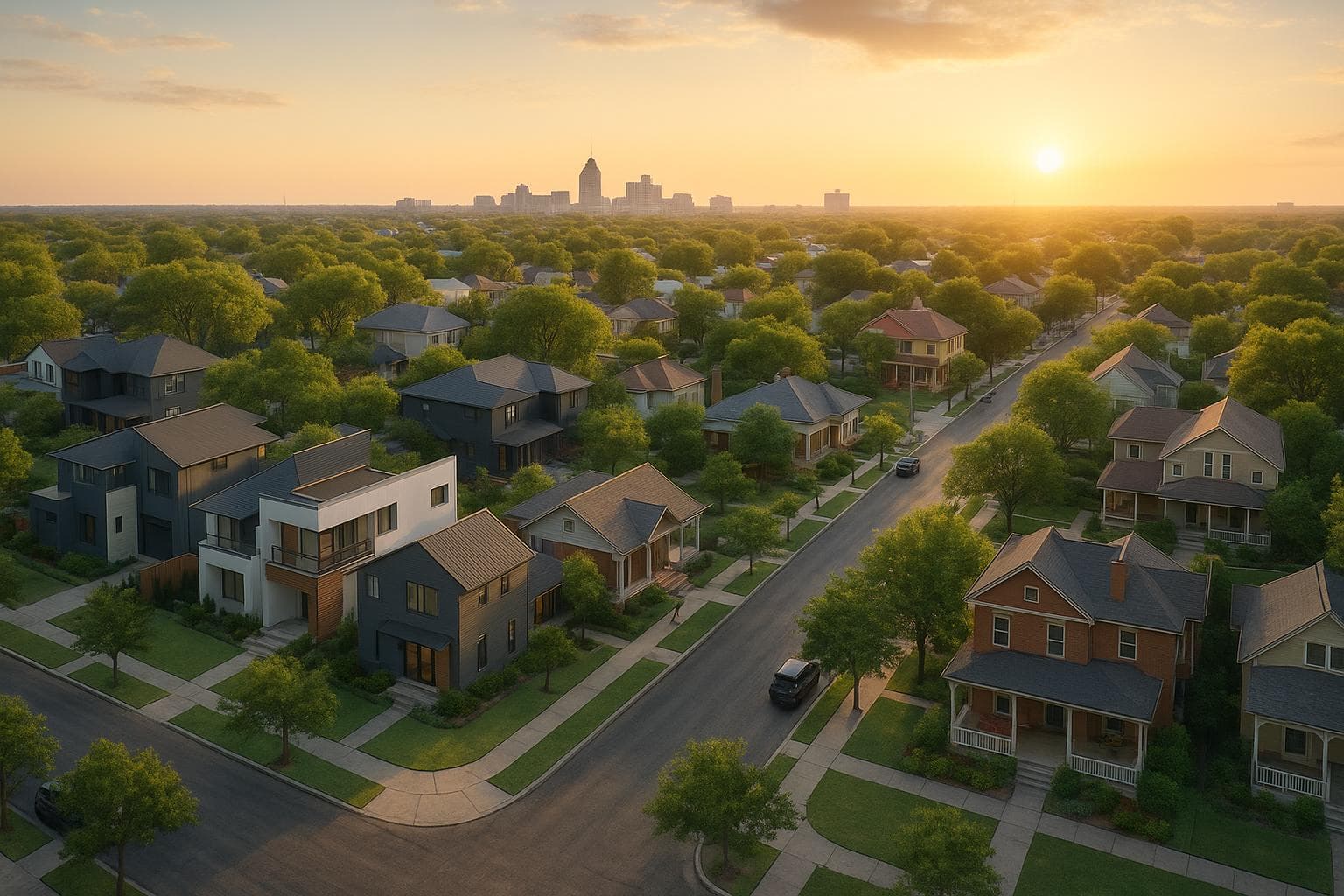
Architecture and price range are varied without feeling incoherent. Expect late-1990s and early-2000s traditional brick construction in communities like the Stone Oak area near Sonterra Boulevard, newer infill construction in more recently developed pockets, and larger estate lots in gated enclaves closer to the 1604 corridor. Price points stretch from the mid-$300,000s for smaller end-unit properties to well above $1 million for custom homes in the most exclusive sections.
What Are Home Prices Doing in Stone Oak Right Now?
As of June 2026, Stone Oak has found a more balanced footing after the intense pace of 2021 and 2022. Median home prices in the 78258 zip code are running between $480,000 and $535,000, with meaningful variation by subdivision, lot size, and school zone proximity. Homes backing to the greenbelt corridors that thread through the neighborhood, those with pools, and those in the most sought-after elementary attendance zones still command a premium and move faster than the general inventory.
What has shifted is buyer behavior. Homeowners who locked in historically low rates a few years ago are staying put longer, which keeps resale inventory constrained even as new construction adds some supply. That scarcity continues to prop up prices in Stone Oak even as rate-sensitive buyers in other parts of the metro have found more negotiating room. In practice, a well-priced home in the $450,000 to $550,000 range still attracts serious buyers within the first week on market.
For sellers, the lesson right now is precision in pricing. Homes overpriced by even three to four percent are sitting. Buyers in this price range are sophisticated, often operating under buyer representation agreements formalized after the NAR settlement changes, and they are comparing your listing against every available comparable. Accurate entry pricing, professional photography, and strategic preparation are the difference between a clean, timely sale and a price reduction that costs you more than the staging ever would have.
Is Stone Oak Still a Good Investment in 2026?
Yes, but with realistic expectations. Stone Oak is not a neighborhood where you will find dramatically underpriced opportunities at this point in the cycle. Appreciation has been consistent precisely because the fundamentals, NEISD schools, U.S. 281 infrastructure, proximity to major medical employment, are well understood by the market and baked into prices.
Where opportunity still exists is in properties that have not been updated since original construction. A 2001 or 2003-era home with original kitchen finishes and dated bathrooms in an otherwise strong subdivision can still be acquired at a meaningful discount to updated comparables. For buyers with the patience and resources to renovate, that spread represents a real advantage in a neighborhood where finished product commands strong prices.
For investors targeting rental income, Stone Oak attracts stable, long-term tenants including medical professionals, corporate relocatees, and military families from Joint Base San Antonio who value the school district and proximity to 281. Cash flow at current purchase prices is harder to achieve, but tenant quality and low vacancy rates make it a sound long-term hold for investors who can accept appreciation-driven returns.
As San Antonio's Most Distinctive Real Estate Advisor, I bring more than transaction volume to this conversation. With a background that includes leading business teams at scale and credentials that require genuine expertise to earn, I approach every Stone Oak conversation with the context that comes from actually knowing this market. That means I will tell you which subdivisions hold value better, which pockets are overpriced, and where the best value still lives.
If Stone Oak is on your radar, whether you are buying your first North Side home, upgrading to a larger lot, or thinking about listing a property you have owned for years, I want to have that conversation. Visit scottcpeck.com or call me directly at 210.264.2507. You deserve an advisor who knows Stone Oak the way I do.
Frequently Asked Questions
Which schools serve Stone Oak, and are they actually as good as people say?
Stone Oak falls primarily within North East Independent School District. Depending on your specific address, students are zoned to various NEISD elementary and middle schools, with high school attendance split between Reagan High School and Churchill High School. Both campuses rank among the stronger performers in Bexar County on Texas Education Agency accountability measures. That said, school zoning is address-specific and changes periodically, so I always verify the exact assigned campus for any property before my buyers finalize an offer.
How long is the commute from Stone Oak to downtown San Antonio or JBSA?
Under typical weekday conditions, the drive from Stone Oak to downtown San Antonio via U.S. 281 south takes approximately 25 to 35 minutes. During peak morning hours, expect 40 to 50 minutes. Many Stone Oak residents work within the North Side medical and technology corridor, which cuts commute times considerably. For military families assigned to Joint Base San Antonio, the 1604 connection to the west side of the installation generally runs 35 to 45 minutes depending on gate traffic.
Are HOA fees in Stone Oak worth it, and what do they actually cover?
Most Stone Oak communities carry HOA fees ranging from roughly $400 to $1,200 per year depending on the subdivision and amenities provided. Gated or amenity-rich communities carry fees at the higher end of that range, while standard planned communities run lower. Coverage typically includes common area maintenance, deed restriction enforcement, and in some cases access to community pools, parks, or fitness facilities. HOA document review is a step I walk every buyer through before any Stone Oak purchase, because what is and is not permitted by the deed restrictions can significantly affect your renovation plans or use of the property.